Categories
Overview
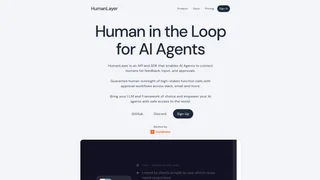
HumanLayer is an AI coding environment built around orchestrating agents and solving hard problems in complex codebases. The homepage presents the product as a serious developer tool, not a simple prompt wrapper, with language that focuses on workflows, control, and scale.
The page also makes the product feel operational. It talks about IDE-style workflows, keyboard-first control, and running Claude Code sessions in parallel, which suggests a product aimed at developers who want AI to behave like a real engineering assistant inside their existing process.
Key Features
- Orchestrate AI coding agents for large codebases.
- Use keyboard-first workflows that prioritize speed and control.
- Run Claude Code sessions in parallel.
- Scale from an individual laptop to an entire team.
- Support worktrees, remote cloud workers, and other engineering primitives.
- Position the tool as a serious coding environment rather than a chatbot.
Use Cases
- Developers can use the platform to tackle hard refactors and multi-step changes.
- Teams can standardize AI-assisted coding workflows across members.
- Engineers can parallelize work and keep context organized across sessions.
- Organizations can evaluate a more structured way to use AI inside codebases.
Product Direction
The site frames the product as a way to get AI to solve harder problems, which is a stronger pitch than simple code completion. That matters because the highest-value coding work is often about coordination, sequencing, and keeping many changes aligned across a codebase.
Why It Matters
HumanLayer stands out because it tries to make AI feel like part of a real engineering workflow. That means the product is less about generating code in isolation and more about helping developers manage the messier parts of software work, including context, parallel sessions, and larger codebase changes. The keyboard-first design and agent orchestration focus make the product relevant for serious teams that want more control than a generic chat interface provides. It is a clear fit for complex engineering environments where the goal is not just to ask for code, but to manage the code-producing process itself. The platform is especially useful when the team needs repeatability and a way to standardize agent work across large repositories. That makes it easier to keep AI assistance useful as projects get larger and more interconnected.
In practice, that kind of product works best when the benefit is immediate and easy to understand. It removes a repeated task, fits into an existing routine, and gives people a reason to keep using it because the payoff shows up quickly without much setup or training.
Tool Overview
Pricing
Similar AI Tools

Stability AI Developer Platform
Stability AI is a developer platform for building image, video, audio, and 3D applications with APIs, sandbox tools, and credit-based pricing.
ChatGPT Code Interpreter
OpenAI sandboxed Python environment within ChatGPT that executes code, analyzes data, creates visualizations, and processes files through natural language conversations.
TeamPal
No-code AI workforce platform for building, customizing, and deploying AI agents across marketing, sales, HR, operations, finance, R&D, design, and IT departments.

Automix
AI-powered career development platform offering resume review, mock interviews, recruiter tools, and AI chat to automate and enhance the job search workflow.
Remalt
Remalt is an AI content workspace where founders and creators orchestrate 9+ LLMs on an infinite visual brainboard to generate platform-ready content for LinkedIn, YouTube and Instagram in under an hour.