Categories
Overview
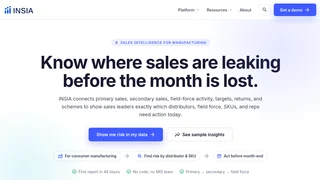
INSIA is a sales intelligence and data analytics platform designed for consumer manufacturing companies that manage complex dealer and distributor networks. It connects primary sales, secondary sales, field-force activity, targets, returns, and schemes into a single unified view, giving sales leaders a daily operating system to detect revenue leakage and take action before month-end instead of discovering problems in the next quarterly review.
The platform ingests data from over 20 source types including databases, CSV and Excel files, marketing platforms, and business applications. It then cleans, standardizes, and transforms that data through a drag-and-drop interface, applying built-in AI and machine learning models to surface risks such as distributor underperformance, retailer churn, coverage gaps, SKU assortment issues, and inventory distortion before they compound into measurable revenue loss.
Key Features
- Data integration across 20+ sources. Connect databases like MySQL, PostgreSQL, Oracle, and SQL Server alongside flat files, Google Sheets, Shopify, Facebook Ads, Google Ads, LinkedIn Ads, and more to centralize all sales data in one place.
- Automated data cleaning and standardization. INSIA generates suggestions to correct errors, match records, and standardize formats without writing SQL or relying on a separate data quality tool.
- Drag-and-drop data transformation. Join, rename, derive, filter, bucket, and impute data through a visual interface that requires no coding, putting data shaping in the hands of business users.
- Push AI proactive alerts. Built-in ML models push personalized insights in plain language to the right person at the right time via WhatsApp or email, with a feedback loop that improves relevance over time.
- No-code predictive analytics. Train and deploy time series forecasting, clustering, and anomaly detection models without writing code. The toolkit auto-selects the best-fit model for each dataset.
- 48-hour risk assessment. Send three files -- primary sales invoices, secondary sales or field-force billing, and sales hierarchy -- and INSIA delivers a risk report covering distributor risk, coverage gaps, assortment gaps, return adjustment impact, and field-force churn signals within two days.
- Role-based personalization. Each stakeholder receives different alerts and dashboards based on their role: zone managers see territory risk, ASMs see beat-level actions, and leadership sees the full revenue picture.
Revenue Leakage Detection
INSIA tracks six common leakage areas. Retailer churn occurs when outlets stop ordering and no one follows up. Distributor underperformance hides behind healthy dispatch numbers while secondary sales slow. Coverage gaps emerge when beats are marked visited but shelf assortment tells a different story. Assortment gaps mean core SKUs are missing from key outlets, letting competitors take the shelf. Out-of-stocks represent demand that exists but supply that does not. Inventory distortion happens when schemes push dispatch into the channel without driving real offtake. Across a typical consumer manufacturing operation, these six areas together represent 7 to 23 percent of revenue at risk each month.
Security and Compliance
INSIA operates over 100 percent HTTPS connections with firewall protection at every layer. Role-based access control operates at the table, entity, and column level, with the option for virtually air-gapped databases. User-level security includes multi-factor authentication and 256-bit elliptic curve encryption with zero-tolerance suspicious activity monitoring. The platform is audited by independent certified public accounting firms and maintains HIPAA, GDPR, and ISO 27001 compliance certifications. Data is stored on AWS in Mumbai or Ohio, with on-premise deployment available for enterprise clients.
Integrations
The platform supports native connectors for MySQL, PostgreSQL, Oracle DB, MS SQL Server, and MariaDB databases. Marketing integrations include Facebook Ads, Google Ads, LinkedIn Ads, and Instagram Analytics. Business tool connectors cover Shopify for ecommerce, AWS S3 for storage, and CSV and Excel for flat files. Additional connectors for Airtable, Chargebee, Intercom, Jira, and Zoho CRM are listed as coming soon. A connector request system lets teams submit integration needs directly to the engineering team for prioritization.
Pros and Cons
Pros:
- Unifies primary sales, secondary sales, and field-force activity into a single connected view, eliminating the fragmented reporting that manufacturing teams typically rely on.
- Delivers a 48-hour risk assessment from just three standard file exports, making onboarding fast compared to traditional data warehouse projects that take months.
- No-code predictive analytics and ML model training put advanced forecasting capability in the hands of business users rather than data science teams.
- Push AI delivers role-specific, natural-language alerts through WhatsApp and email, reaching field teams on the channels they already use.
- Strong security posture with HIPAA, GDPR, and ISO 27001 compliance, role-based access down to the column level, and enterprise on-premise deployment options.
Cons:
- Pricing is not publicly available on the official website; interested buyers must request a demo and go through a sales-led evaluation.
- Connector ecosystem is narrower than general-purpose BI platforms, with several integrations still listed as coming soon.
- Product is purpose-built for consumer manufacturing with dealer and distributor networks, making it less applicable to industries with direct-to-consumer or simple sales models.
- Limited to two AWS cloud regions or on-premise deployment, which may not meet data residency requirements in all markets.
- As a smaller company, the support team and partner ecosystem are likely smaller than those of established enterprise BI vendors.
Who Should Use INSIA
INSIA is best suited for mid-size and large consumer manufacturing companies that operate multi-tier distribution networks of dealers, distributors, and field sales representatives. Teams that currently rely on month-end MIS reports to understand where revenue went wrong will gain the most value from the daily early-warning system. Companies with complex schemes, returns, and assortment management across hundreds of SKUs and territories are the core use case. Organizations outside of consumer manufacturing, businesses with direct-to-consumer models, or teams looking for general-purpose business intelligence may find the platform too narrowly focused for their needs. Small companies with simple, single-tier distribution and teams that prefer self-serve, publicly priced SaaS products should evaluate whether the sales-led engagement model fits their procurement process.
Tool Overview
Pricing
Similar AI Tools

VFitter
VFitter is an AI-powered professional networking platform that connects students and professionals with mentors, collaborators, and career opportunities through Ikigai-based matchmaking.
Crono
AI sales execution platform that helps B2B teams automate prospecting, enrichment, outreach, follow-ups, and revenue workflows.
Tableau AI
Tableau is an AI-powered visual analytics and business intelligence platform by Salesforce that helps organizations turn data into actionable insights with agentic analytics.
Databricks AI
A unified data analytics and AI platform that combines data engineering, data warehousing, machine learning, and generative AI on an open lakehouse architecture.
Zetta
Zetta is an automated business intelligence platform with a conversational AI data analyst, dashboards, and metrics builder for data-driven teams.