Categories
Overview
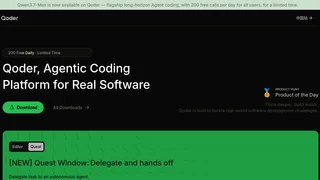
Qoder is an open-source agentic coding platform purpose-built for developers who want to harness AI directly in their terminal workflow. At its core is qodercli, a versatile command-line interface that acts as an AI coding agent capable of understanding codebases, generating code, and executing complex development tasks. Qoder is designed for individual developers, engineering teams, and AI enthusiasts who want to integrate autonomous coding agents into their daily workflow without leaving the terminal.
How It Works
Qoder operates through a client-server architecture where qodercli communicates with AI models to process natural language coding requests. The CLI can be run interactively as a full terminal UI or in a non-interactive one-shot mode for quick task delegation. Developers invoke qodercli within their project directories, and the tool analyzes the codebase context, understands the request, and generates or modifies code accordingly. It supports working directory scoping via the -w flag, maximum turn limits for task control, and JSON-formatted machine-readable output for integration into automated pipelines.
Key Capabilities
Qoder offers a comprehensive set of features for AI-assisted development. The interactive TUI mode provides a persistent coding assistant that developers can converse with in real time. The one-shot mode accepts a single prompt and exits after completing the task, making it ideal for CI/CD pipelines and automated workflows. qodercli includes max-turns controls to cap agent iteration depth, machine-readable JSON output for programmatic consumption, and support for long or non-ASCII prompts through temp-file based input. The tool integrates with tmux for PTY-based interaction and supports background execution for long-running tasks.
Agent Skills Marketplace
Beyond the CLI, Qoder features a vibrant community ecosystem through its Agent Skills marketplace. Hosted on GitHub as qoder-community, this open repository allows developers to share, discover, and install specialized agent skills ranging from code review automation to project scaffolding. Skills are categorized by role and use case, with frontmatter metadata for discoverability. The community supports both English and Chinese skill documentation, and contributions are welcomed via pull requests. This marketplace transforms Qoder from a standalone CLI into an extensible platform that grows with its user community.
Use Cases
Qoder is well-suited for a range of development scenarios. Solo developers use it as an always-available pair programmer that can scaffold projects, write boilerplate code, debug issues, and suggest refactors. Engineering teams deploy it for standardized code generation tasks, automated PR reviews, and batch refactoring across repositories. DevOps practitioners integrate qodercli's one-shot mode into CI/CD pipelines for automated code quality improvements. Open-source maintainers leverage the skill marketplace to share reusable coding patterns and best practices with their communities.
Intended Users
The platform serves multiple developer profiles. Individual contributors benefit from on-demand coding assistance without context switching to a web-based AI chat. Technical leads use Qoder to enforce coding standards across teams through shared agent skills. Platform engineers build custom skills for their organization's specific frameworks and conventions. The dual-language community documentation (English and Chinese) makes Qoder accessible to a global developer audience.
Pricing and Availability
Qoder is open-source under the MIT license, making the CLI tool free to use, modify, and distribute. The qoder-community repository and all agent skills are publicly available on GitHub. Installation is available via Homebrew for macOS users through the homebrew-qoder tap, and the source code is accessible for building from source on other platforms. The project maintains an active presence on Discord, Reddit, and YouTube for community support and updates.
Tool Overview
Pricing
Similar AI Tools
Stability AI Developer Platform
Stability AI is a developer platform for building image, video, audio, and 3D applications with APIs, sandbox tools, and credit-based pricing.
ChatGPT Code Interpreter
OpenAI sandboxed Python environment within ChatGPT that executes code, analyzes data, creates visualizations, and processes files through natural language conversations.
ParseHub Web Scraper
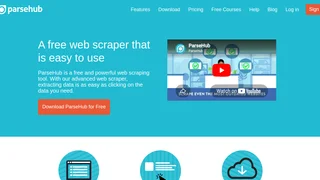
ParseHub is a powerful visual web scraping tool that extracts data from any website without writing code. It handles JavaScript, AJAX, pagination, and login forms, making it suitable for data analysts, marketers, researchers, and developers who need structured web data for lead generation, price monitoring, market intelligence, and data science workflows.
Rafter
Scan GitHub repositories for security vulnerabilities, secrets, and code issues with AI-powered SAST and actionable fix suggestions. Rafter connects to your GitHub with one click, delivers severity-tagged findings with plain-English remediation steps, and integrates with Claude Code, Cursor, and other AI coding agents.
TeamPal
No-code AI workforce platform for building, customizing, and deploying AI agents across marketing, sales, HR, operations, finance, R&D, design, and IT departments.