Categories
Overview
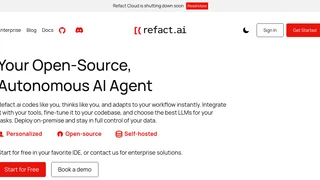
Refact.ai is an open-source AI coding agent built for individual developers, engineering teams, and enterprises who want to accelerate software development without surrendering control of their source code. It works directly inside the IDEs developers already use, combining real-time code completion, an in-editor chat, and an autonomous agent that can carry multi-step engineering tasks from planning through testing.
How It Works
Refact.ai analyzes your repository using retrieval-augmented generation (RAG), drawing context from your codebase, documentation, and project structure so its suggestions reflect your actual patterns, libraries, and APIs. Developers can connect multiple large language models, choosing between providers such as Anthropic Claude, OpenAI GPT, Google Gemini, and others, or bringing their own API key. The autonomous agent can plan a task, edit multiple files, run code, and iterate on the results within the editor.
Key Features
- Autonomous agent: Plans and executes complex, multi-file engineering tasks step by step, including writing, debugging, and testing code.
- Code completion: Provides real-time, context-aware autocomplete suggestions as you type.
- In-IDE chat: Lets you ask questions, generate code, and get explanations in plain language without leaving the editor.
- Repository awareness: Uses RAG to understand the whole codebase rather than only the open file.
- Multi-model support: Works with several LLM providers and supports bringing your own key.
- Tool integrations: Connects with GitHub and GitLab, databases, Docker, and CI/CD pipelines for end-to-end workflows.
Supported IDEs and Languages
Refact.ai integrates with VS Code and the JetBrains family, including PyCharm, WebStorm, IntelliJ IDEA, GoLand, and CLion, alongside additional editors. It supports a broad range of modern programming languages and frameworks such as Python, JavaScript, TypeScript, Java, Rust, PHP, C++, and SQL.
Privacy and Deployment
Code privacy is central to Refact.ai. The project is open source, and teams can run it as a cloud service or self-host it on premises for full control over where code and data reside. Enterprise deployments add options such as private cloud hosting, model fine-tuning, and reduced telemetry, making it suitable for organizations with strict security or compliance requirements.
Pricing
Refact.ai offers a free plan that includes unlimited code completion, in-IDE chat, and limited access to the autonomous agent. A Pro plan is available at $10 per month with expanded agent usage and a larger chat context window. Enterprise pricing is custom and covers on-premise or private-cloud deployment, fine-tuning, and additional privacy controls.
Use Cases
- Speeding up day-to-day coding with context-aware completion and chat.
- Delegating multi-step tasks such as refactors, bug fixes, and test writing to the agent.
- Keeping proprietary code in-house through self-hosted or on-premise deployment.
- Standardizing AI assistance across a team while choosing the underlying model.
Tool Overview
Pricing
Similar AI Tools
ChatGPT Code Interpreter
OpenAI sandboxed Python environment within ChatGPT that executes code, analyzes data, creates visualizations, and processes files through natural language conversations.
ParseHub Web Scraper
ParseHub is a powerful visual web scraping tool that extracts data from any website without writing code. It handles JavaScript, AJAX, pagination, and login forms, making it suitable for data analysts, marketers, researchers, and developers who need structured web data for lead generation, price monitoring, market intelligence, and data science workflows.

Rafter
Scan GitHub repositories for security vulnerabilities, secrets, and code issues with AI-powered SAST and actionable fix suggestions. Rafter connects to your GitHub with one click, delivers severity-tagged findings with plain-English remediation steps, and integrates with Claude Code, Cursor, and other AI coding agents.

9Router
A free, open-source local proxy that routes AI coding tools across 40+ model providers with smart quota-aware fallback.
Stable Diffusion WebUI (AUTOMATIC1111)
Open-source browser interface for Stable Diffusion AI image generation with txt2img, img2img, inpainting, LoRA, and extensible plugin architecture.