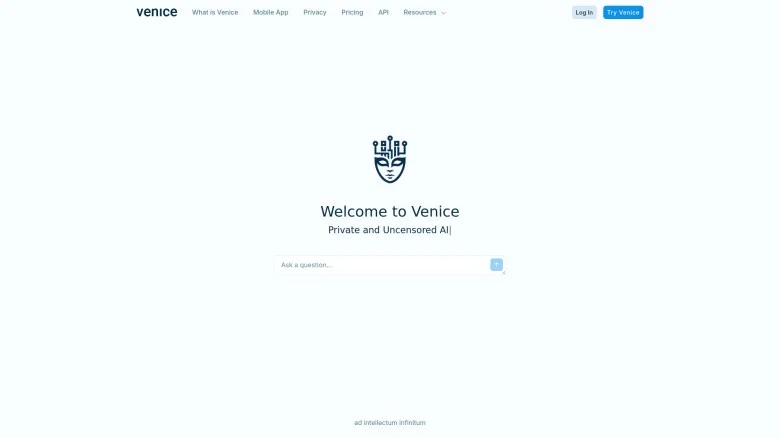
Venice AI Review: Privacy, Performance, and Capabilities
As mainstream generative artificial intelligence services increasingly rely on extensive user data collection, centralized telemetry, and restrictive content moderation filters, privacy-conscious developers and creators have sought viable alternatives. Venice AI has emerged as one of the most prominent answers to this challenge. Founded by Erik Voorhees, the platform combines leading open-source models with a zero-retention infrastructure, offering an uncensored, permissionless environment for text, code, image, and video generation. In this detailed review, we evaluate Venice AI across its privacy architecture, generative model performance, developer tooling, and overall pricing value.
What Is Venice AI?
Venice AI is a multimodal generative AI application and developer API designed around data sovereignty and computational privacy. Instead of locking users into proprietary closed-source models with strict corporate guardrails, Venice orchestrates open-weights models provided by leading research groups including Meta, Mistral, Qwen, DeepSeek, and Black Forest Labs. The platform can be accessed through a modern web interface on desktop and mobile browsers, or integrated programmatically into external applications using an OpenAI-compatible REST endpoint.
Architecture and Privacy Verification
The defining value proposition of Venice AI is its commitment to data minimization and user anonymity. While standard consumer AI chatbots retain conversation histories to refine proprietary models or serve targeted advertising, Venice enforces clear technical boundaries to guarantee confidential computing.
- Zero Prompt Retention: Prompts and responses are processed in memory and purged immediately after completion. Venice does not maintain central logs linking queries to user accounts.
- Local Storage and Encryption: Chat histories remain stored inside the user browser session or can be encrypted with client-side keys, preventing backend access by platform administrators.
- Anonymous Sign-Up Options: Users can authenticate using Web3 wallets like MetaMask or WalletConnect alongside standard email accounts, requiring no phone verification or personal identifiers.
- Decentralized Compute Distribution: Inference workloads are distributed across private compute networks, avoiding single points of failure and censorship risks.
Hands-On Performance Across Modalities
To assess real-world utility, we tested Venice across its primary creative and technical workflows.
Text Generation and Complex Reasoning
Venice AI grants access to frontier open-source language models, including Meta Llama 3.3 70B, DeepSeek R1 and V3, and Qwen 2.5. In our evaluations, technical analysis and creative generation proceeded without the refusal triggers common to closed commercial platforms. When querying sensitive historical contexts, security research scripts, and nuanced philosophical arguments, the models provided balanced and direct responses without lecturing or bias injection. DeepSeek R1 in particular demonstrated exceptional deductive reasoning on algorithmic logic and mathematical problem-solving.
Software Engineering and Coding
Writing scripts, debugging database queries, and generating frontend templates was fluid and responsive. The interface includes built-in syntax highlighting, copy shortcuts, and prompt continuity. Developers can leverage open models to prototype complex microservices without worrying that proprietary codebases will be leaked or stored in remote training pools.
Image Synthesis with Flux.1
Image generation in Venice AI is powered by Black Forest Labs Flux.1 (Dev and Schnell) along with Stable Diffusion 3.5. We found generation speeds fast and prompt adherence precise. Photorealistic portraits, typography rendering, and intricate vector graphics rendered cleanly. The user interface allows granular adjustments of aspect ratios (1:1, 16:9, 9:16), generation steps, and negative prompting parameters, giving digital artists full creative leeway.
Video Creation and Motion Models
Venice integrates advanced generative video pipelines including Kling, Wan, and Seedance. Generating 5-second cinematic motion clips from text prompts or reference images required under 80 Venice credits. Motion coherence and lighting transitions were impressive for an integrated web tool, eliminating the need to set up dedicated ComfyUI environments on local GPU hardware.
Developer API and Ecosystem Integration
For technical teams building AI agents or automated pipelines, Venice offers an OpenAI-compatible API endpoint at api.venice.ai. Developers can adapt existing codebases simply by swapping the base URL and passing an API key:
- Familiar SDK Syntax: Standard chat completions payloads and streaming responses work directly with the official OpenAI Node.js and Python SDKs.
- Agent Ready: Autonomous frameworks like LangChain, CrewAI, and AutoGen can point to Venice endpoints to ensure agent memory and operational logs remain strictly confidential.
- Transparent Billing: Compute usage is tracked via published per-token rates or deducted from bundled monthly credit allowances.
Pricing, Credits, and Subscription Tiers
Venice AI uses a transparent subscription model complemented by universal credits for high-compute workloads like video synthesis and API calls. 100 Venice credits equal $1.00 in compute value.
| Plan | Monthly Cost | Credit Allotment | Key Inclusions |
|---|---|---|---|
| Free | $0 | Standard limits | Basic text chat, standard open models, essential daily images, zero data retention |
| Pro | $18/mo | 100 credits/mo | Unlimited private text generation, priority queue, high-res Flux images, persona studio |
| Pro Plus | $68/mo | 7,500 credits/mo | All Pro features, $75 API credit value, 2-month credit banking, advanced video models |
| Max | $200/mo | 22,500 credits/mo | All Pro features, $225 API credit value, 3-month credit banking, maximum API throughput |
Payment options include conventional credit cards as well as cryptocurrencies including Bitcoin, Ethereum, Solana, and Base tokens. Pro users can also take advantage of referral bonuses to accumulate platform credits.
Strengths and Weaknesses
Pros
- True zero-retention privacy policy with client-side encrypted chat history.
- No corporate censorship filters or refusal guardrails on frontier open models.
- Comprehensive multimodal support spanning text, code, high-res images, and video.
- Drop-in OpenAI SDK compatibility for developers and automated agents.
- Anonymous account creation via Web3 wallets and crypto payment support.
Cons
- Proprietary closed-source models like GPT-4o or Claude 3.5 Sonnet are not hosted natively.
- Advanced video generation and high-resolution upscaling require ongoing credit consumption.
- Free tier is subject to daily volume caps during high traffic periods.
Final Verdict
Venice AI successfully delivers a powerful, private, and uncensored alternative to the walled gardens of Big Tech AI. For software engineers, researchers, investigative journalists, and creative professionals who refuse to compromise on data confidentiality or deal with overreaching safety filters, Venice AI stands out as a compelling, production-ready solution.