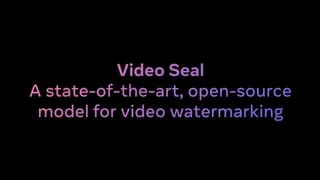
Video Seal is an open-source video watermarking tool from Meta focused on authenticity and provenance. The product is positioned as a way to embed imperceptible yet robust watermarks into video so creators and media teams can better verify where content came from.
The project also emphasizes efficiency through a temporal watermark propagation technique, which suggests the system is built to stay practical even when video workloads are large. That makes it feel like a serious media integrity tool rather than a novelty demo.
Key Features
- Embed imperceptible watermarks into video files.
- Keep those watermarks robust against common manipulations.
- Use temporal watermark propagation for better efficiency.
- Support provenance and authenticity workflows for media.
- Help creators and companies verify the origin of video content.
- Combat deepfakes and content tampering risks.
Use Cases
- Content creators can prove ownership or origin more easily.
- Media companies can protect video assets across distribution channels.
- Trust and safety teams can verify whether clips have been manipulated.
- Organizations can add provenance to content in a deepfake-heavy environment.
Authenticity Layer
The main point of the product is trust. If a watermark stays invisible to the viewer but resilient enough to survive common edits, it becomes a useful layer for authenticity checking and media governance.
Why It Matters
Video Seal matters because video authenticity is increasingly difficult to prove in a world where synthetic edits and deepfakes are common. A watermarking system that stays robust while remaining imperceptible gives creators and media organizations a practical way to protect their content. The open-source angle also makes the project more approachable for teams that want to test provenance tooling without locking themselves into a black box. That combination of authenticity, resilience, and openness makes the product relevant far beyond a demo page.
These products are strongest when the workflow stays short and concrete. The best value usually comes from making the next step obvious, reducing repetition, and giving the user a clear result they can use immediately.
That clarity also helps the homepage itself. When the page matches the real workflow, visitors can understand the product faster, trust the pitch sooner, and decide whether it fits the job they need done.
Smaller utility products especially benefit from that directness because the payoff has to be visible quickly. If the user can try it, understand it, and see the outcome in a single pass, the product feels much more credible.