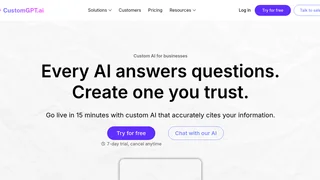
CustomGPT.ai is a no-code platform for building business AI agents from an organization's own content. It lets teams connect websites, documents, helpdesks, and cloud apps, then deploy custom chat assistants that answer with source citations instead of generic model guesses. The product targets support, research, and internal knowledge workflows for companies that need accurate responses grounded in verified company data.
How Custom Agents Are Built
CustomGPT.ai follows a three-step flow: connect data, customize the agent, and deploy it where users already work. The platform ingests more than 1,400 file types plus integrations with Google Drive, SharePoint, OneDrive, Notion, Confluence, HubSpot, Zendesk, Shopify, WordPress, and many CMS and knowledge-base systems. Non-technical users can launch an agent in minutes by uploading files or pointing to a website sitemap without writing code.
Accuracy, Security, and Branding
CustomGPT.ai emphasizes anti-hallucination retrieval and cites sources in responses so users can verify answers. The company states customer data is not used to train external large language models, and the platform advertises SOC 2 Type II and GDPR-aligned controls. Agents can be white-labeled with logos and backgrounds, and Premium and Enterprise tiers can remove CustomGPT branding from the widget experience.
Deployment Options
Finished agents can be embedded on websites, shared internally, or connected through API and integration paths documented in the product docs. CustomGPT.ai supports 92 languages, which helps global support and employee-facing assistants serve multilingual audiences from the same knowledge base. Teams can choose model behavior presets focused on speed, accuracy, or understanding, with deeper model control on Enterprise.
Use Cases
- Customer support: Answer repetitive product and policy questions from help centers and documentation.
- Internal research: Let employees query SOPs, technical docs, and policy libraries with cited answers.
- Sales enablement: Provide fast responses based on product sheets, case studies, and proposal content.
- Associations and education: Publish member-facing assistants trained on curated organizational resources.
Plans and Pricing
Public self-serve pricing includes Standard at $99 per month, or $89 per month billed annually at $1,068 per year, with 500 credits per month, one team member, two AI agents, 5,000 documents per agent, and seven-day analytics. Premium costs $499 per month, or $449 per month billed annually at $5,388 per year, with 2,500 monthly credits, three team members, five agents, 20,000 documents per agent, one-year analytics, and removal of powered-by branding. Enterprise is custom-priced, typically cited in the $2,000 to $6,000 per month range, with dedicated support, forward-deployed engineering, and advanced security controls. All paid self-serve plans include a seven-day free trial.
Integrations and Content Ingestion
Beyond file uploads, CustomGPT.ai connects to the systems where company knowledge already lives. Website sitemaps, CMS platforms, cloud drives, ticketing tools, and ecommerce storefronts can feed agents through native connectors documented on the integrations page. That breadth matters for support teams whose answers depend on product pages, internal wikis, and policy PDFs stored in different places. Because the platform accepts more than 1,400 file formats, legacy documentation does not need to be converted before it becomes searchable by an agent.
Implementation and Maintenance
After launch, teams can keep agents current by syncing websites, drives, and knowledge bases on supported integrations. Auto-sync sources such as sitemaps, Notion, Confluence, SharePoint, and helpdesk content reduce the manual work of re-uploading files whenever policies or product details change. For organizations running proof-of-concept pilots, the Standard plan offers a lower-cost entry point before expanding agent count, document volume, and analytics retention on Premium.
Limitations and Considerations
Usage is credit-based, so high-volume support teams must monitor message and action consumption against plan limits. Complex enterprise deployments with custom security or workflow requirements are sales-led rather than fully self-serve. Agent quality still depends on source content hygiene, so outdated or conflicting documents will affect response accuracy even with strong retrieval.