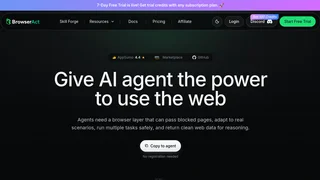
BrowserAct is a browser automation platform purpose-built for AI agents, giving them the ability to interact with real websites without getting blocked. It provides a managed browser layer with stealth fingerprinting, built-in CAPTCHA solving, session isolation, and an agent-native runtime that returns clean, low-token web data instead of raw DOM. Developers, data engineers, and AI agent builders use BrowserAct to run web scraping at scale, automate multi-account workflows, and connect agent tools to live web data through CLI, MCP, and API interfaces.
Key Features
- Stealth Fingerprinting and Anti-Blocking. BrowserAct generates unique browser fingerprints with TLS rotation and residential proxies so most bot-detection checks never trigger. When they do, the built-in CAPTCHA solver handles reCAPTCHA, Cloudflare Turnstile, DataDome, and HUMAN Security automatically.
- Three Browser Modes. Reuse local Chrome login state for authenticated tasks, use stealth private mode with rotating identities for bulk scraping, or deploy stealth fixed-identity mode for stable multi-account management, all with full session isolation.
- Unlimited Concurrency. Run multiple agents and tasks in parallel without account mixups or state pollution. Each browser session gets its own fingerprint, proxy, cookies, and workspace.
- Agent-Native Runtime. Interfaces are designed for how language models work. Clean indexed page structure replaces raw DOM, actions are exposed as stable click targets, semantic browser memory lets agents reuse the right identity, and sensitive operations require confirmation by default.
- Skill Forge and Marketplace. Build custom browser skills using natural language and share them through SkillHub. Pre-built skills cover LinkedIn profile scraping, Amazon product extraction, and social media data collection.
- Human-in-the-Loop Handoff. For 2FA and other hard stops, the remote-assist feature creates a live link for mobile or desktop takeover, then returns control to the agent.
Browser Modes and Identity Management
Local Chrome mode reuses the signed-in Chrome profile on your machine so agents can work inside authenticated sites with cookies, SSO, and extensions intact. Stealth private mode generates a fresh fingerprint and rotating proxy IP for every task, ideal for bulk scraping. Stealth fixed-identity mode binds each account to a stable browser fingerprint, a static residential proxy, and dedicated workspace for long-running multi-account operations.
Fingerprint profiles cover over 30 attributes including user agent, WebRTC, canvas, and WebGL. Built-in residential IPs support country-level targeting, and both rotating and static proxy options cover scraping and account management use cases.
Pricing and Plans
BrowserAct offers a free tier with 100 daily credits and five free local browser profiles, plus three paid subscription plans. The Basic plan costs $13 per month (billed $156 yearly) with 10,000 monthly credits, 10 simultaneous tasks, and up to five static proxies. The Essential plan at $56 per month (billed $672 yearly) provides 50,000 monthly credits, 20 simultaneous tasks, and up to 25 static proxies. The Advanced plan at $96 per month (billed $1,152 yearly) includes 100,000 monthly credits, 40 simultaneous tasks, and up to 50 static proxies. Every paid plan comes with a 7-day free trial.
Infrastructure services use a credit-based pay-as-you-go model. Dynamic proxy bandwidth costs 5,000 credits per GB (as low as $3.20 per GB). Static proxies are priced per proxy per month based on location and tier. Workflow steps consume 5 credits each, as low as $0.0032 per step. A cloud browser service is listed as coming soon.
Integrations and Agent Ecosystem
BrowserAct connects to popular AI coding tools through a CLI-based skill system. Agents like Claude Code, Cursor, and Codex can install the browser-act skill and drive local Chrome sessions with natural language commands. The platform exposes an MCP server for programmatic browser tasks and a REST API for custom integrations. No-code users can connect BrowserAct to Make, n8n, and Zapier to add web data extraction to existing automation pipelines. The platform partners with cloud providers including AWS, Microsoft Azure, and Google Cloud, and is available on the AWS Marketplace and AppSumo.
Pros and Cons
Pros:
- Built-in CAPTCHA solver handles reCAPTCHA, Cloudflare, DataDome, and HUMAN Security without third-party plugins.
- Three distinct browser modes cover local authenticated browsing, bulk scraping, and multi-account management.
- Agent-native design returns clean indexed data instead of raw DOM, saving tokens and improving LLM reasoning.
- Credit-based pricing with a free tier lowers the barrier to entry while paid plans scale predictably.
- Deep agent ecosystem with CLI skills, MCP server, API, and no-code platform integrations.
Cons:
- The free tier is limited to 100 daily credits and five local browsers, which may be insufficient for production workloads.
- Cloud browser service with 24/7 background execution is not yet available and has no confirmed release date.
- Static proxy pricing is not transparently listed and requires location-based quoting.
- Advanced features like multi-account scale and high concurrency require the Essential or Advanced plans.
Who Should Use BrowserAct
BrowserAct fits teams and individuals who need reliable, AI-compatible web automation that handles blocking and CAPTCHAs without custom infrastructure. Data engineers scraping at scale, developers building AI agents that interact with live websites, and digital marketers managing multi-account social media operations will find the most value. The free tier and low entry price make it accessible for solo developers and small teams, while the higher plans support production-grade concurrency for agencies and growth teams.
BrowserAct is less suited for users who only need occasional one-off scraping, since the credit model rewards consistent usage. Teams that already maintain their own proxy and CAPTCHA infrastructure may find the platform redundant, though the agent-native runtime and browser isolation features still offer value for AI-driven workflows.