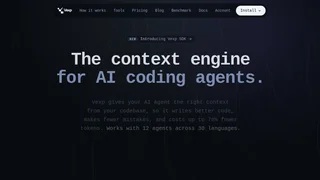
Vexp is a local-first context engine that feeds AI coding agents precise, relevant slices of your codebase instead of dumping whole files into the model. It parses a repository into a dependency graph, runs hybrid search with graph ranking, and returns compressed context capsules that cut token usage by up to 70% while improving answer quality. It is built for individual developers and engineering teams who rely on AI assistants and want lower cost, fewer incorrect edits, and better multi-file reasoning without sending source code to a third party.
How It Works
Vexp indexes a project with tree-sitter parsing and stores everything in a local SQLite database, so no code leaves the machine and there are no network calls during indexing or retrieval. Rather than treating a codebase as flat text, it builds a graph of symbols and their relationships, then ranks results using a mix of full-text search, TF-IDF, and graph centrality. When an agent requests context, Vexp assembles a focused capsule and applies skeleton or pivot reduction to strip non-essential code, reporting up to a 97.7% reduction on the parts that do not matter for the task at hand. The result is a smaller, sharper prompt that keeps the agent grounded in the code that actually relates to the current change.
Key Capabilities
- Graph-native indexing that maps dependencies across functions and files.
- Hybrid retrieval combining full-text and TF-IDF search with graph centrality ranking.
- Skeleton and pivot reduction that compress context and lower token spend.
- Session memory that records project conventions and past decisions so agents stay consistent across a working session.
- Impact analysis that surfaces dependent code before a change, plus logic-flow tracing across the call graph.
- Intent detection with an optional GPU-accelerated on-device model.
- Twelve MCP tools spanning specialized search, memory, and monitoring functions.
Integrations And Compatibility
Vexp connects to agents through the Model Context Protocol and advertises support for twelve agents across roughly thirty languages, including Claude Code, Cursor, Windsurf, GitHub Copilot, Continue.dev, Zed, Augment, Codex, Opencode, Kilo Code, Kiro, and Antigravity. It ships as a Visual Studio Code extension and as a standalone command-line tool installed from npm, so it fits both editor-centric and terminal-centric workflows. Because it speaks MCP, it slots into existing agent setups without a bespoke integration for each tool.
Use Cases
- Debugging and exploring unfamiliar code with accurate, scoped context.
- Refactoring safely by reviewing impact analysis before making edits.
- Context-aware code generation that respects existing conventions.
- Understanding dependencies that span many files in large repositories.
Pricing
Vexp uses a freemium model, and the Starter tier needs no account or credit card to begin.
| Plan | Price | Key Features |
|---|
| Starter | Free forever | Up to 2,000 nodes, single repository, 7 MCP tools (4 core plus 3 memory), 20 pipeline and skeleton calls per day, VS Code or CLI |
| Pro | $19/month | Up to 50,000 nodes and 3 repositories, all 12 MCP tools, intent detection, CodeLens, email support |
Both tiers allow unlimited individual repositories, and the standalone CLI is available on either plan.
Benchmarks And Credibility
On SWE-bench Verified, a suite of 100 real GitHub issues, Vexp reports a 73% pass@1 resolution rate at about $0.67 per task, which it frames as roughly 22% cheaper than the next best agent, and it claims seven to ten unique issue resolutions that other agents did not reach. Because retrieval runs entirely on-device, those results are produced without sending source code off the machine. The project is developed in the open, with documentation, a published benchmark writeup, and source available on GitHub under the Vexp-ai organization.
Privacy And Local-First Design
Everything Vexp does happens on your own hardware. Indexes live in local SQLite, retrieval makes no network calls, and code never uploads to an external service, which makes it a practical fit for teams with strict data-handling or compliance requirements. For developers weighing AI assistance against the cost and confidentiality of shipping their code to a remote service, Vexp positions local-first retrieval as the way to get both cheaper context and stronger privacy.