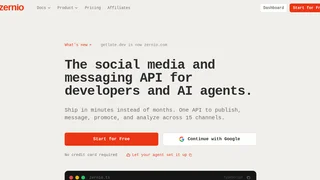
Zernio is a unified social media API and scheduling platform designed specifically for software developers, marketing agencies, and technical teams. The service acts as a single integration layer that abstracts the complexity of connecting to multiple individual social media networks and messaging channels. By providing normalized endpoints for publishing, inbox management, and analytics, the platform allows businesses to build programmatic social media features directly into their own software products and automation workflows without undergoing separate developer verification processes for each supported platform.
The platform is optimized for modern software architecture, supporting interactions via standard REST endpoints, webhooks, and client SDKs. In addition to traditional software integrations, the service supports AI agents by offering developer tools like Model Context Protocol (MCP) servers, making it easier to integrate automated social publishing and reader capabilities into AI assistants and LLM-driven tools.
Key Features
- Unified API Endpoint: Connects to over 15 social platforms through a single standardized interface, eliminating the need to write and maintain custom API integrations for each individual network.
- Programmatic Content Scheduling: Offers full scheduling control with support for queues, bulk publishing via CSV uploads of up to 500 posts, and automated first-comment placement.
- Cross-Platform Messaging: Consolidates direct messages from seven messaging channels into a single inbox, with support for automated replies and comment-to-DM triggers.
- Developer-First Tooling: Provides official Node.js and Python SDKs, a Command Line Interface (CLI), and a Model Context Protocol (MCP) server designed for direct AI agent integration.
- Platform Compliance: Operates as a verified partner with platforms like Meta and LinkedIn, allowing developers to deploy social integrations without individual app review procedures.
Supported Channels and Platforms
The service offers compatibility across a broad spectrum of 15 social media networks and messaging applications. Developers can publish media and manage interactions on Twitter/X, Instagram, Facebook, LinkedIn, TikTok, YouTube, Pinterest, Reddit, Bluesky, Threads, Google Business, Telegram, Snapchat, WhatsApp, and Discord. The API automatically handles format normalization, asset transcoding, error retries, and rate limits for each network, ensuring that images and videos are optimized for the target destination before publication.
Developer Tooling and SDKs
To accelerate implementation, the platform provides official software development kits (SDKs) in Node.js and Python, allowing teams to interact with the API using native code structures. A Command Line Interface (CLI) is also available for managing connected accounts and testing endpoints from the terminal. For teams building autonomous AI agents, the native Model Context Protocol (MCP) server exposes publishing, reading, and scheduling tools directly to LLMs, enabling agents to handle social media tasks programmatically without custom middleware.
Pricing and Plans
Billing is structured around a usage-based, pay-per-connected-account pricing model where the cost per account scales down as volume increases. The first two connected social accounts are provided free of charge, making the platform accessible for small projects and testing.
| Connected Accounts | Price Per Month | Included Features |
|---|
| First 2 Accounts | $0 | Full API access, basic posting, and community support |
| 3 to 10 Accounts | $6 per account | All free features, bulk scheduling, and priority support |
| 11 to 100 Accounts | $3 per account | All features, higher rate limits, and team collaboration |
| 101 to 2,000 Accounts | $1 per account | High-volume API access, custom webhooks, and SLA support |
| 2,001+ Accounts | Custom Pricing | Dedicated infrastructure, custom contracts, and enterprise SLA |
For WhatsApp integrations, the service charges a platform fee starting at $2 per month for each active phone number, in addition to Meta's standard template and conversation messaging fees. All standard plans include access to the unified API, SDKs, and developer documentation.
Pros and Cons
Pros:
- Consolidating 15 platform APIs into a single endpoint saves significant development and maintenance time for engineering teams.
- The pay-per-connected-account model offers a low-cost entry point with two free accounts, allowing developers to prototype without upfront expenses.
- Built-in Model Context Protocol support simplifies the integration of social workflows into AI agent systems.
Cons:
- Usage-based costs can accumulate rapidly for marketing agencies or SaaS products that require hundreds of client accounts.
- Integrating WhatsApp requires managing separate Meta messaging fees alongside the platform's active number charges.
- The developer-centric design lacks the extensive pre-built user interface templates found in traditional social media management dashboards.
Who Should Use Zernio
The platform is ideal for SaaS founders who want to add social media sharing or messaging features to their products, agencies managing multiple client brands programmatically, and software engineers building custom automation workflows. It is particularly valuable for developers building AI agents and virtual assistants that need to read and write social media content autonomously through a secure, standardized interface.