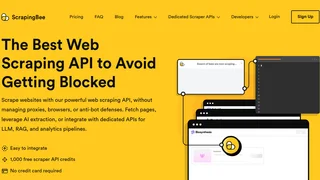
ScrapingBee is a web scraping API that handles proxies, headless browsers, and anti-bot countermeasures so developers can extract data from websites without building and maintaining their own scraping infrastructure. It is built for developers, product teams, and data engineers who need reliable web data at scale for use cases like market intelligence, e-commerce monitoring, AI training, and lead enrichment.
Key Features
- HTML API with proxy rotation: Fetch raw HTML from any public website in a single API call. ScrapingBee automatically rotates residential and stealth proxies, handles CAPTCHAs, and manages retries so you get clean page content without managing your own proxy fleet.
- JavaScript rendering: For pages that rely on client-side rendering, ScrapingBee runs headless Chrome with support for waiting on selectors, executing custom JavaScript scenarios, clicking elements, filling forms, and capturing screenshots of the rendered output.
- AI-powered data extraction: Define extraction rules in JSON or describe the fields you need in natural language with AI Query. ScrapingBee returns structured JSON or clean Markdown without writing custom parsers for each target website.
- Dedicated scraper APIs: Pre-built endpoints for Google Search, Amazon, YouTube, Walmart, and ChatGPT return structured, ready-to-use data without custom parsing. The Fast Search API delivers real-time SERP results in under one second.
- CLI and MCP server: The command-line interface and Model Context Protocol server let AI coding tools like Claude, ChatGPT, Cursor, and Gemini run scraping workflows directly. Skills packages provide pre-built automation for common scraping tasks.
- No-code and low-code integrations: Native connectors for make, n8n, and Zapier let non-developers drop web scraping into automated workflows without writing code.
Pricing and Plans
ScrapingBee offers subscription plans billed monthly, with each plan including a set number of API credits. A basic request costs one credit, while features like JavaScript rendering, premium proxies, or AI extraction consume additional credits. New users get 1,000 free credits with no credit card required.
| Plan | Price | Credits/Month | Concurrent Requests |
|---|
| Freelance | $49 | 250,000 | 50 |
| Startup | $99 | 1,000,000 | 100 |
| Business | $249 | 3,000,000 | 200 |
| Business+ | $599 | 8,000,000 | 400 |
| Custom | Custom | Custom | Custom |
All prices are exclusive of VAT. Users can upgrade plans mid-cycle, renew early, or purchase one-time credit add-ons if they run out before the next billing period. ScrapingBee only charges for successful requests, defined as those returning HTTP 200, 404, or 410 status codes.
Dedicated APIs and Integrations
Beyond the general-purpose HTML API, ScrapingBee provides dedicated endpoints for popular data sources. The Google Search API returns organic results, ads, news, and maps. The Amazon and Walmart APIs deliver product listings, pricing, and review data. The YouTube API surfaces video metadata, comments, and transcripts. The ChatGPT API collects model responses in structured formats for analysis and monitoring.
For teams already using automation platforms, ScrapingBee integrates natively with make, n8n, and Zapier. Developers can also use the MCP server to give AI coding assistants direct access to scraping capabilities, or the CLI to script scraping workflows from the terminal.
Pros and Cons
Pros:
- No infrastructure to manage: proxies, browsers, CAPTCHAs, and anti-bot handling are all abstracted behind a single API.
- AI extraction reduces the need for per-site parsing logic, returning structured JSON from natural-language queries.
- Dedicated APIs for Google, Amazon, YouTube, Walmart, and ChatGPT save development time on common data sources.
- SOC 2 Type 2 compliance and GDPR readiness make it suitable for enterprise procurement.
- Free tier of 1,000 credits lets developers test the service before committing to a paid plan.
- CLI and MCP server enable AI-assisted scraping workflows from coding assistants and terminal environments.
Cons:
- JavaScript rendering, premium proxies, and AI extraction consume more credits per request, which can increase costs for complex scraping jobs.
- The Freelance plan at $49/month lacks JavaScript rendering and premium proxy support, limiting its usefulness for sites with heavy anti-bot protection.
- Dedicated APIs are limited to a fixed set of sources; scraping custom or niche websites still requires the general HTML API and custom parsing.
- Concurrent request limits are tied to plan tiers, which may bottleneck high-volume or time-sensitive scraping workflows on lower-tier plans.
Who Should Use ScrapingBee
ScrapingBee is a strong fit for development teams that need reliable web data at scale but do not want to build and maintain their own proxy rotation, headless browser fleet, and anti-bot infrastructure. It works well for e-commerce price monitoring, market intelligence gathering, AI and LLM data pipelines, and lead enrichment workflows. Teams already using no-code automation platforms will benefit from the make, n8n, and Zapier integrations.
The service is less suited for teams with very tight budgets who scrape mostly simple, static pages, since the entry-level Freelance plan excludes premium proxies and JavaScript rendering. It may also not be the best choice for projects that need to scrape sources not covered by the dedicated APIs and where custom parsing effort is the main bottleneck rather than infrastructure management.