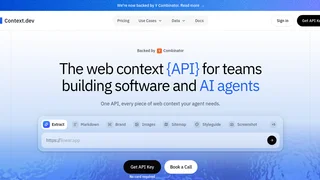
Context.dev is a web context API platform built for software teams and AI product builders who need live web data, brand intelligence, and structured extraction without maintaining their own crawlers, scrapers, and enrichment pipelines. Backed by Y Combinator, the service combines web scraping, company and brand lookups, screenshot capture, and schema-driven AI extraction behind one API key and developer-friendly SDKs.
How It Works
Teams sign up through the dashboard or let a coding agent follow the published agent authentication guide to register and retrieve credentials. After email verification, you copy an API key and call REST endpoints or install an official SDK for TypeScript, Python, Ruby, Go, or PHP. Each request consumes API credits based on the endpoint called, while Logo Link logo URLs use a separate quota that does not deduct credits.
The platform is designed to replace the patchwork of vendors many teams assemble for scraping, brand assets, and company enrichment. Instead of building internal data infrastructure, you pull markdown, HTML, sitemaps, screenshots, logos, colors, fonts, and firmographics on demand and feed them directly into agents, onboarding flows, or retrieval pipelines.
Web Extraction APIs
Context.dev exposes a full web extraction surface for reading the live internet. You can scrape any URL to clean markdown or rendered HTML, crawl entire sites, discover page URLs through sitemap extraction, and capture viewport or full-page screenshots. Web search results, image extraction, and crawl-to-markdown workflows help teams keep RAG indexes current without brittle parsers.
For structured output, the Extract endpoint crawls a site and maps page content into a JSON Schema you define, which pairs naturally with Zod or similar schema tools in application code. Separate product extraction endpoints pull individual product details or product listings with AI assistance. These flows support agent workflows such as checking a competitor pricing page, researching a company domain, or turning arbitrary URLs into typed records your application can reason over.
Brand and Company Intelligence
Beyond raw page content, Context.dev resolves domains, work emails, company names, and even stock tickers into typed brand profiles. Responses can include logos, brand colors, fonts, slogans, industry tags, social links, and firmographic fields useful for CRM enrichment, profile builders, and personalized onboarding.
The Get Styleguide endpoint returns a fuller visual identity package with colors, UI elements, and typography extracted from a website. Logo Link offers a lightweight alternative: embed any company square logo with a single image URL served from a global CDN, with no SDK or backend call required. Identification endpoints can match messy transaction strings to brands using optional location and merchant category hints, which helps finance and expense products turn opaque descriptors into recognizable merchants.
Typical Use Cases
- AI agents with live web access: Let an agent read current pricing, docs, or blog posts instead of relying on frozen training data.
- Fresh RAG and knowledge bases: Crawl sitemaps, convert pages to markdown, and pipe content into embeddings without maintaining custom crawlers.
- Onboarding autofill: Pre-populate company name, logo, brand color, and description fields from a work email domain to reduce signup friction.
- Sales and GTM enrichment: Turn a domain reference into logos, industry, location, and social profiles for decks, CRM records, or internal research tools.
- Branded product experiences: Power documentation sites, directories, job boards, and affiliate experiences with accurate company visuals and metadata.
Developer Experience and Integrations
Context.dev emphasizes fast integration. Self-serve signup issues an API key immediately, documentation covers agent quickstarts and API references, and customer stories cite teams integrating in roughly ten minutes. The homepage also provides copy-paste agent setup instructions for tools like Cursor so an AI coding assistant can install the SDK and wire the first calls into a codebase.
Rate limits scale with plan tier, from 30 calls per minute on the free work-email tier up to 800 calls per minute on Scale 2.5M. Logo Link has no rate limits. Failed or blocked requests are not billed, and the service does not add surcharges for JavaScript rendering, anti-bot handling, or premium proxies on web scraping calls.
Plans and Pricing
New accounts receive 500 free API credits with no card required, plus Logo Link quota for testing. Work-email signups get 30 requests per minute on the free tier, while signups with consumer email providers receive 250 credits at 10 requests per minute until upgraded.
Paid self-serve plans include Starter at $49 per month for 30,000 credits, Pro at $149 for 200,000 credits, Growth at $299 for 500,000 credits, Scale 1M at $499 for one million credits, and Scale 2.5M at $949 for 2.5 million credits. Overage pricing decreases on higher tiers, and startups or nonprofits can apply for up to 30 percent off for one year. Enterprise is available for teams needing custom volume, SSO or SAML, SCIM provisioning, uptime SLAs, dedicated support, and annual invoicing.
Data Freshness and Support
Cached brand data refreshes quarterly by default, with brands older than three months fully re-fetched on request. Customers can request manual brand updates through the site update form. First-time domain lookups may take 10 to 30 seconds while the platform crawls and processes a site, so production apps often prefetch domains, extend client timeouts, or use async polling for batch jobs.
Support channels vary by plan, ranging from email on Starter to priority support on Growth and dedicated Slack access on larger tiers. A dedicated Slack community is also available for integration questions. Customers such as Mintlify, DocsBot, daily.dev, Vizzy, and Architect report faster onboarding, higher activation, and less time spent maintaining brand-scraping infrastructure after adopting the API.