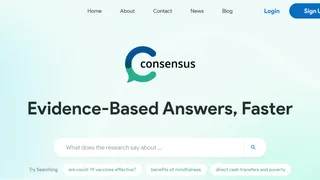
Consensus is an AI-powered academic search engine designed to help researchers, students, and clinicians find and synthesize insights from over 250 million peer-reviewed research papers. Unlike general-purpose AI chatbots, Consensus draws exclusively from published scientific literature, including licensed full-text content from leading publishers, and provides cited, evidence-based answers to research questions. Used by over 10 million researchers across more than 170 university library partnerships, Consensus accelerates literature reviews from days to minutes while maintaining academic rigor.
How It Works
Consensus accepts natural language research questions and searches its database of 250M+ peer-reviewed papers to surface relevant studies. The platform uses GPT-4 to synthesize findings, extract key insights, and generate summaries with direct citations to the source papers. Every result links back to the underlying study, so users can verify claims and trace evidence to its origin. The platform is purpose-built for academic research rather than general web search, meaning it does not surface blog posts, news articles, or unverified claims.
Key Features
- Consensus Meter: Ask a yes-or-no research question and the Consensus Meter instantly visualizes how much the evidence agrees or disagrees, categorizing studies as supporting, opposing, or neutral with a quick, scannable read on the state of the research.
- Deep Search: Builds a comprehensive search strategy automatically, expanding key terms, identifying conflicting arguments, and exploring the citation graph to turn days of manual literature review into minutes of AI-assisted discovery.
- Study Snapshots: Extracts and displays key findings, study design, population, sample size, and methodology from each paper at a glance, reducing the need to open and skim every PDF individually.
- Clinical Guidelines Filter: Narrows results to approximately 50,000 clinical guidelines and 8 million articles from the top 1,000 medical journals for quick, trusted clinical answers.
- Study Design Filters: Specify timeframes, populations, methodologies, and other parameters directly in the prompt, and Consensus automatically applies the correct search filters.
- Citation Export: Export citations in multiple formats for direct use in reference managers and academic writing workflows.
Intended Users
Consensus serves graduate students and PhD candidates conducting dissertation research, academic faculty preparing literature reviews, clinicians seeking evidence-based answers to clinical questions, and undergraduate students learning to engage with primary research. The platform is also used by research institutions through library partnerships that provide campus-wide access. Students, faculty, and US healthcare professionals with valid credentials receive up to 40% off paid subscriptions.
Plans and Pricing
Three tiers from free to deep research, with annual billing offering savings versus monthly rates.
| Plan | Monthly | Annual | Key Features |
|---|
| Free | $0 | --- | Basic paper search, 15 Pro messages/month, up to 3 Deep reviews/month |
| Pro | $10 | $120/yr ($10/mo) | Unlimited Pro messages, 15 Deep reviews/month, unlimited access to all research tools |
| Deep | $45 | $540/yr ($45/mo) | Unlimited Pro messages, 200 Deep reviews/month, unlimited access to all research tools |
The Free plan keeps basic paper search and limited AI analysis available at no cost. The Pro plan unlocks unlimited AI-powered search and analysis for individual researchers. The Deep plan targets power users, researchers, and clinicians conducting frequent comprehensive literature reviews. Students, faculty with valid .edu emails, and US healthcare professionals with a valid NPI number can claim up to 40% off. Annual billing on Pro saves $60 per year and on Deep saves $240 per year versus monthly billing.
How Consensus Differs from General AI Chatbots
General AI tools like ChatGPT may generate plausible-sounding but unsupported claims or fabricate citations. Consensus is trained to search, retrieve, and summarize only from its database of peer-reviewed literature, grounding every answer in published studies. The platform does not generate text from its own knowledge, it surfaces what the research actually says, with full transparency into which studies informed each answer. This makes it suitable for academic work where source traceability and evidence quality matter.
Limitations and Considerations
Consensus is effective for finding and summarizing published research but does not replace critical appraisal of individual studies. Users still need domain expertise to evaluate methodology, sample quality, and relevance to their specific research question. The platform covers peer-reviewed literature extensively but may have gaps in very niche, emerging, or non-English research areas. Free tier usage is capped, making it suitable for occasional exploration but insufficient for sustained research workflows. The platform is web-based and requires an internet connection with no offline mode currently available.