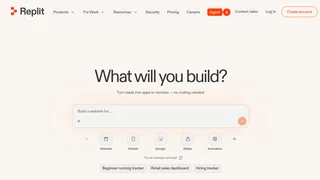
Replit is a collaborative, cloud-based software development platform that enables developers to build, test, host, and deploy software applications entirely within a web browser. Designed to remove the friction of local environment setup, the platform provides an instant-on development workspace supporting over 50 programming languages. By combining a multi-user editor with integrated compute resources, database storage, and deployment pipelines, Replit serves as a comprehensive ecosystem for hobbyists, educators, and professional teams looking to accelerate their software development lifecycle. The platform has transitioned to an AI-native workspace, placing artificial intelligence at the center of the developer workflow.
Key Features
- Cloud-Based Multi-Language IDE: Provides a fully functional online code editor, terminal, and file system that runs in the cloud. Developers can write, compile, and run code instantly without configuring local software, downloading SDKs, or managing runtime environments on their personal machines.
- Real-Time Collaborative Coding: Enables multiple users to edit the same codebase simultaneously, much like Google Docs. It features shared terminals, live chat, inline comments, and shared preview links, making it ideal for interactive pair programming, technical mentoring, and distributed teams.
- Autonomous Replit Agent: Utilizes advanced generative AI to construct full-stack web applications from natural language descriptions. The agent autonomously plans the architecture, generates the file structure, installs package dependencies, configures database schemas, and deploys the finished application while allowing human developers to collaborate.
- Instant Hosting and Deployments: Offers built-in deployment tools to host web applications, APIs, and background processes. It automatically configures custom domains or Replit subdomains, provisions SSL certificates, manages environment variables, and scales server resources to handle user traffic.
- Integrated Storage and Databases: Includes built-in key-value stores and managed PostgreSQL database options configured out-of-the-box. This eliminates the need for external database hosting, allowing developers to set up state persistence and store user data securely with minimal configuration.
- Version Control and Checkpoints: Integrates Git-like version control directly into the workspace, allowing developers to track changes, view differences between revisions, and revert to previous checkpoints easily, ensuring project recovery in case of errors.
How It Works
When a developer opens a workspace in Replit, the platform provisions a containerized virtual machine (called a Repl) in the cloud. This virtual machine is pre-configured with the selected programming language's runtime environment, package managers, and shell access. Users can write code in the browser-based editor, and their changes are instantly synced to the cloud container, where they can run commands, install third-party libraries, and test their code in real-time. For web applications, Replit automatically exposes a public URL that forwards traffic to the running port inside the container, providing an immediate preview of the running application. When the project is ready for production, the developer can deploy it to Replit's hosting infrastructure, which moves the code to a optimized environment with automated resource scaling.
Use Cases
- Rapid Prototyping and MVP Development: Startups and solo developers can spin up new workspaces instantly, build applications quickly with AI assistance, and deploy a working minimum viable product in minutes to share with customers or investors.
- AI-Assisted Full-Stack Development: Software engineers can leverage the Replit Agent to code alongside them, allowing the agent to handle repetitive boilerplate code, set up complex backend endpoints, and design user interfaces while the engineer focuses on high-level architecture.
- Interactive Programming Education: Teachers and bootcamps can create team-based coding assignments, share interactive code templates, and review students' progress in real-time, facilitating a hands-on learning environment without configuration barriers.
- Lightweight Services and Cron Jobs: Teams can host lightweight bots, API endpoints, webhooks, and scheduled cron jobs that run continuously in the background, executing tasks like system monitoring or automated notifications without managing dedicated servers.
Pricing and Plans
Replit uses a usage-based pricing structure driven by computational credits alongside subscription tiers that provide monthly credit allowances.
| Plan | Price | Key Features |
|---|
| Starter | $0 | Basic online IDE access, limited daily AI interactions, and 1 published application. |
| Core | $20/month | Full Replit Agent access, unlimited workspaces, up to 5 collaborators, and monthly credit allowance. |
| Pro | $95/month | Credit rollover, priority support, higher limits, up to 15 collaborators, and advanced database backups. |
| Enterprise | Custom | SSO/SAML integration, dedicated virtual private cloud (VPC) peering, custom seat limits, and SLA support. |
Additional computational resources, database storage, and deployment hosting consume credits on a pay-as-you-go basis when the monthly allowance included in a subscription tier is exhausted. Credit consumption for the AI Agent is effort-based, meaning complex tasks that require extensive computational processing or prolonged reasoning loops will utilize more credits than simple code edits.
Security and Privacy
Replit implements multiple layers of security to protect developer workspaces and user data. Workspaces are containerized and isolated from one another to prevent unauthorized access or resource interference. The platform manages secrets securely through environment variables, preventing sensitive API keys, database credentials, and passwords from being hardcoded in public repositories or shared workspaces. For enterprise clients, Replit supports identity provider integrations using SSO and SAML protocols, enabling centralized access management. Additionally, team workspaces can restrict member permissions to prevent unauthorized code modifications or deployment changes, keeping codebases secure during collaborative development.
Platform Limitations
- Credit-Based Consumption: The transition to a credit-based model for AI services and compute resources means that heavy development activity and continuous app deployments can result in unpredictable monthly costs if credit limits are exceeded.
- Resource Limits on Low Tiers: Projects running on starter or lower-tier virtual machines share server resources with other users, which can lead to temporary CPU throttling, memory limitations, or slower startup times for large codebases.
- Cloud-Only Dependency: Because the IDE, terminal, and workspace files reside in the cloud, developers must have a continuous and stable internet connection to edit files, run applications, or manage their deployments.