Categories
Overview
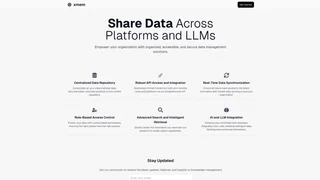
Xmem is an open-source memory orchestration layer that provides AI agents and LLM-powered applications with persistent long-term memory, session context, and knowledge graph capabilities. It solves the problem of AI memory loss by acting as an external hippocampus that any AI model can plug into, enabling systems to remember past interactions, user preferences, and project context across sessions without relying solely on the model limited context window.
Key Features
- Long-Term Memory: Store and retrieve knowledge, notes, and documents using vector search across supported databases including Qdrant, ChromaDB, and Pinecone. The system maintains over 2.3 million knowledge links for semantic retrieval.
- Session Memory: Track recent conversations, instructions, and context for recency and personalization using in-memory storage or MongoDB, ensuring each LLM call has immediate access to the current conversation state.
- Knowledge Graph: Link concepts, facts, and user context in real time with a dynamic evolving structure, enabling AI agents to reason about relationships and traverse connections between pieces of information for GraphRAG queries.
- RAG Orchestration: Automatically assemble the most relevant context for every LLM call by combining long-term knowledge, session state, and graph relationships without manual tuning or prompt engineering.
- AGM Belief Revision: Formally resolve memory contradictions using Alchourron-Gardenfors-Makinson theory. When incoming facts conflict with existing stored beliefs, the system applies mathematically grounded retraction rules rather than silently overwriting or accumulating contradictions.
- Classifier Agent: Automatically analyze and route incoming information into structured memory domains including user profiles, temporal events with date resolution, code knowledge with symbol-level annotations, conversational summaries, and architectural descriptions.
- Multi-Provider Orchestration: Work with Gemini, Claude, OpenAI, OpenRouter, Amazon Bedrock, and Ollama through a unified interface with automatic failover. If one provider becomes unavailable, Xmem seamlessly routes to the next available provider.
- MCP Server: Expose memory tools through the Model Context Protocol for integration with Cursor, Claude Desktop, Windsurf, n8n, and other MCP-compatible clients. Tools include save_memory, search_memories, and retrieve_answer.
- Developer Agent Plugins: First-party integrations for Claude Code, Codex, Cursor, Hermes, OpenClaw, and OpenCode. The Hermes plugin provides workspace deep-scanning, auto-capture of conversation turns, and dream mode for consolidation.
How It Works
Xmem operates as a pipeline of specialized AI agents coordinated by LangGraph, backed by a deterministic execution layer and three purpose-built storage engines. When data arrives, the Classifier Agent analyzes the input and routes it to the appropriate memory domain. The knowledge graph component creates links between related concepts, facts, and entities. Before each LLM call, the Orchestrator assembles the most relevant context from all storage engines within a controlled token budget. The belief revision engine continuously maintains consistency by superseding outdated information, retracting contradicted facts, and consolidating duplicate entries.
Use Cases
- AI Agent Memory: Give coding assistants, customer support bots, and virtual assistants persistent memory so they remember user preferences, past decisions, and conversation history across sessions without repeating context.
- Developer Workflows: Enable developer agents like Claude Code and Cursor to maintain project context, recall codebase decisions, and carry knowledge across sessions. The built-in scanner indexes entire Git repositories into a queryable knowledge graph.
- Enterprise Memory: Deploy as a self-hosted memory layer for regulated industries including healthcare, finance, and legal where data residency and auditable belief-revision logs are required for compliance.
- Multi-Agent Systems: Provide shared memory pools for teams of AI agents working on the same task, with belief revision to resolve conflicting information between agents and maintain a consistent world model.
Tool Overview
Pricing
Similar AI Tools

Brilliant Directories
Brilliant Directories is a white-label platform for launching membership sites, online directories, and community websites with built-in payments, SEO, and AI tools.

Poppy AI
Multiplayer AI workspace for analyzing videos, podcasts, PDFs, and voice notes to create viral content and brainstorm ideas collaboratively.

Stability AI Developer Platform
Stability AI is a developer platform for building image, video, audio, and 3D applications with APIs, sandbox tools, and credit-based pricing.

TeamPal
No-code AI workforce platform for building, customizing, and deploying AI agents across marketing, sales, HR, operations, finance, R&D, design, and IT departments.
Syllabbles
All-in-one platform to create ebooks, flipbooks, audiobooks, podcasts, and designs from any source — AI, files, URLs, voice, or video.