Danh mục
Tổng quan
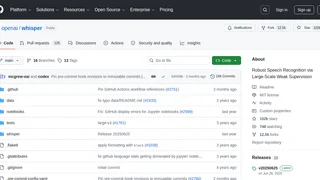
Whisper is an open-source automatic speech recognition (ASR) system developed by OpenAI that transcribes and translates spoken language across 100+ languages. Built on a Transformer sequence-to-sequence architecture and trained on 680,000 hours of weakly supervised multilingual audio data, it delivers robust speech-to-text capabilities that run entirely on local hardware. Developers, researchers, and enterprises use Whisper for applications ranging from transcription pipelines to accessibility tools and language translation services.
Architecture and Training
Whisper uses an encoder-decoder Transformer that processes audio as log-Mel spectrograms with 30-second sliding windows. The encoder converts the spectrogram into a latent representation, and the decoder autoregressively predicts text tokens. A distinctive design choice is the use of special tokens for task specification: the model can switch between transcription, translation, and language identification based on the input prompt tokens. This multitask approach replaces the traditional pipeline of separate voice activity detection, language classification, and ASR models with a single unified network. The training data spans multiple domains, languages, and recording conditions, making Whisper particularly robust to background noise, accents, and varied audio quality.
Model Sizes and Performance
Whisper offers six model sizes to balance speed and accuracy. The smallest, tiny (39M parameters), requires about 1 GB VRAM and runs roughly 10x faster than the large model. The large-v3 (1.55B parameters) offers the highest accuracy at around 10 GB VRAM. The turbo model (809M parameters) provides an optimized middle ground with approximately 8x speed over large-v3 while maintaining near-identical accuracy. English-only variants (.en) are available for tiny, base, small, and medium, offering slightly better performance on English speech compared to the multilingual equivalents. Language-specific accuracy varies: Whisper performs best on high-resource languages such as English, Spanish, German, and French, with word error rates below 10% on standard benchmarks. Performance on lower-resource languages is comparatively weaker but still competitive for a single model covering 99 languages.
Key Capabilities
Whisper handles multilingual speech recognition with automatic language detection, speech translation from any supported language into English, and spoken language identification. It also performs voice activity detection within the same architecture. The model accepts any audio format that ffmpeg can decode, including MP3, WAV, FLAC, and M4A. Output is text with optional word-level timestamps and segment-level metadata. Through the Python API, developers can access lower-level methods for custom decoding strategies, temperature-based sampling, and vocabulary filtering.
Use Cases
Common applications include automated meeting transcription, podcast and lecture captioning, voice-controlled interfaces, media subtitling, call center analytics, and language learning tools. Because the model runs locally with no internet dependency, it is suitable for privacy-sensitive environments such as healthcare, legal, and defense where audio data cannot be sent to cloud APIs. Researchers use Whisper as a foundation for fine-tuning on domain-specific audio corpora. Its open-source nature has led to extensive community adoption, including web demos, mobile ports, browser-based versions running via WebAssembly, and integrations with media servers and automation tools.
Pricing and Licensing
Whisper is released under the MIT License, permitting free use, modification, and distribution for both personal and commercial purposes. Both the model weights and source code are freely available on GitHub. OpenAI also offers Whisper as a hosted API through their platform, which charges per second of audio processed, but the open-source project itself carries no licensing costs.
Limitations
Whisper does not perform real-time streaming natively — it processes audio in fixed 30-second chunks, though community ports have added streaming support. Accuracy degrades on highly accented, overlapping, or extremely noisy speech. The model can occasionally produce hallucinations, especially on silence or non-speech audio. The English-only models outperform the multilingual versions for English tasks, so choosing the right variant matters. Large model sizes require GPU hardware with sufficient VRAM for reasonable inference speed.
Tổng quan công cụ
Bảng giá
Công cụ AI tương tự
ChatGPT Code Interpreter
OpenAI sandboxed Python environment within ChatGPT that executes code, analyzes data, creates visualizations, and processes files through natural language conversations.
ParseHub Web Scraper
ParseHub is a powerful visual web scraping tool that extracts data from any website without writing code. It handles JavaScript, AJAX, pagination, and login forms, making it suitable for data analysts, marketers, researchers, and developers who need structured web data for lead generation, price monitoring, market intelligence, and data science workflows.
Rafter
Scan GitHub repositories for security vulnerabilities, secrets, and code issues with AI-powered SAST and actionable fix suggestions. Rafter connects to your GitHub with one click, delivers severity-tagged findings with plain-English remediation steps, and integrates with Claude Code, Cursor, and other AI coding agents.
Syllabbles
All-in-one platform to create ebooks, flipbooks, audiobooks, podcasts, and designs from any source — AI, files, URLs, voice, or video.
Amical
Open-source AI dictation app that types 4x faster with voice. Works in any app with context-aware formatting, custom vocabulary, and 100+ language support.