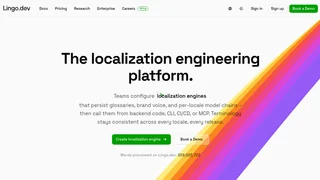
Lingo.dev is an open-source localization engineering platform designed to automate software translation and internationalization workflows across developer builds using AI-driven context pipelines, stateful translation APIs, and automated repository pull requests.
Localization Engineering Infrastructure
Translating modern web and mobile applications often presents significant operational challenges for software engineering teams. Traditional translation management systems require manual export of JSON or i18n key files, leading to out-of-sync strings, missing UI context, broken frontend layouts, and delayed product release cycles. Lingo.dev solves these challenges by embedding stateful localization logic directly into software development pipelines. By analyzing source code trees, UI component hierarchies, AST structures, and variable placements, Lingo.dev ensures that machine translation engines understand precise grammatical context before writing translated string dictionaries.
Key Platform Capabilities
Lingo.dev provides a comprehensive suite of developer-centric tools engineered to handle internationalization tasks automatically during routine code commits:
- CI/CD pipeline automation: Automatically detect newly added or modified i18n string keys in GitHub pull requests and trigger instant localized dictionary updates without human oversight.
- Stateful LLM context preservation: Maintain deep contextual awareness across translation iterations, ensuring brand terms, technical variables, pluralization rules, and UI placeholder tags remain fully intact.
- CLI and SDK support: Execute localization operations directly from terminal commands, node scripts, or programmatic API endpoints integrated into custom deployment build scripts.
- Open-source core architecture: Self-host localization microservices on local infrastructure or utilize Lingo.dev cloud managed infrastructure for scaled team collaboration.
- Multi-format file compatibility: Native support for JSON, YAML, PO, XLIFF, React i18next, Android XML, and iOS string file formats.
- Continuous translation memory syncing: Automatically catalog approved manual edits into a persistent translation memory database, guaranteeing that previously reviewed string translations are reused consistently across future releases.
Developer Workflows and Integration
Engineering teams integrate Lingo.dev directly into their existing continuous integration pipelines to eliminate manual translation handover steps. When developers submit code changes containing new user interface strings, Lingo.dev scans modified source files, extracts raw text tokens, and queries context-aware translation models. The platform then automatically pushes updated localization dictionaries back to the target repository as a verified pull request, allowing engineering teams to ship multilingual applications without slowing down deployment velocity or missing product sprint deadlines.
Furthermore, developers can run the Lingo.dev command-line interface directly during local development to validate localized string keys prior to committing changes. The CLI analyzes project translation files, flags missing translation keys, detects mismatched variable interpolation tokens, and reports potential text truncation risks caused by language length variations.
Primary Industry Use Cases
Organizations deploy Lingo.dev across a variety of application environments demanding rapid software localization and multi-region market expansion:
- Global SaaS deployment: Continuously localizing dashboard interfaces, pricing pages, customer onboarding flows, and transactional email templates into dozens of target languages.
- Mobile application internationalization: Managing iOS and Android localized string files across fast-paced release sprints while preserving platform-specific string formatting standards.
- Open-source project community translation: Enabling community contributors and automated bots to keep technical documentation, web landing pages, and desktop app interfaces updated across global developer communities.
- Enterprise compliance and regional rollout: Streamlining multi-region software deployments while maintaining strict brand terminology consistency and meeting strict regional accessibility standards.
- E-commerce storefront expansion: Automating localized product descriptions, checkout fields, and currency formatting strings across international e-commerce subdomains.
Pricing Tiers and Access Options
Lingo.dev offers a hybrid business model featuring open-source access alongside managed cloud subscription tiers for growing engineering organizations.
| Plan Tier | Monthly Pricing | Translation Volume | Supported Core Features |
|---|
| Community Open Source | $0 / month | Self-hosted / custom LLM keys | Full source code access, self-hosted CLI, community support forum, custom LLM key integration |
| Developer Cloud | $30 / month | Up to 50,000 words / month | Managed API endpoints, GitHub Actions integration, standard context models, automated pull requests |
| Team & Enterprise | Custom volume pricing | Unlimited translation credits | Dedicated translation memory, custom fine-tuned LLM context, SLA guarantees, SSO authentication, enterprise security audit logs |
Free open-source users can connect their own API keys from supported AI model providers, paying only for the underlying language model infrastructure consumed during translation runs.
Security and Code Privacy Standards
Maintaining security over proprietary codebase strings is essential for enterprise development teams. Lingo.dev processes string dictionaries using secure TLS encryption in transit and AES-256 encryption at rest. The platform does not retain customer source code beyond the active translation context window, ensuring compliance with SOC 2 data handling frameworks, GDPR privacy requirements, and strict enterprise security standards.