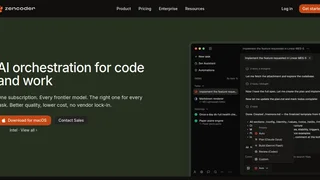
Zencoder is an AI coding agent platform from For Good AI Inc. that routes work across frontier language models instead of locking teams into a single vendor. It targets professional developers and engineering organizations that want agents to plan specifications, implement changes, run verification, and coordinate work across codebases, IDEs, and business tools. The product spans Zenflow Code for software delivery, Zenflow Work for cross-tool automations, and IDE agents embedded in VS Code and JetBrains editors.
Key Features
- Multi-model orchestration: Different models handle different phases of a task, such as planning with Claude Opus, building with Google Gemini, and reviewing with OpenAI Codex, so each step uses a model suited to reasoning, speed, or verification.
- Agentic autonomy with human control: Agents can plan, build, test, and verify across a codebase while developers approve once, run tasks in parallel, and redirect work at any point.
- Full codebase context: Multi-repo indexing, architectural awareness, and dependency mapping let agents understand a stack before editing files or crossing service boundaries.
- Built-in quality gates: Tests, linting, and code review run on generated changes so output is checked against team standards before merge.
- Workflow automation: Pre-built and custom workflows cover feature work, bug fixes, refactors, scheduled PR reviews, dependency updates, and daily bug triage.
- Cross-tool work orchestration: Zenflow Work connects to Jira, Slack, Notion, Gmail, Calendar, Linear, GitHub, and more than 100 integrations for standups, release notes, meeting prep, and ticket-driven intake.
- IDE-native agents: VS Code and JetBrains plugins let developers review diffs, accept changes, run tests, and steer agents without leaving the editor.
- Enterprise governance: Role-based permissions, approval gates, audit trails, SSO, and certifications including SOC 2 Type II, ISO 27001, and ISO 42001 support regulated teams.
IDE and Editor Integrations
Zencoder ships IDE agents for VS Code and JetBrains IDEs. Inside the editor, agents can edit files, explore repositories, run tests, and surface diffs as changes happen. Multi-repo support indexes and searches across repositories so edits in one project can account for dependencies elsewhere. Teams can encode standards, architectural patterns, and domain knowledge as reusable Skills packages. Agents also connect to Jira, GitHub, Slack, and custom MCP endpoints directly from the IDE.
Codebase Context Handling
Before writing code, Zencoder agents index repositories to build architectural and dependency context. That context supports parallel execution across files, modules, and repos, with each agent working in an isolated environment. Cross-agent review lets one agent hand output to another model for a second pass, which helps catch issues without restarting the full task. For larger organizations, multi-repository intelligence is designed to reason across shared dependencies and cross-repo impacts whether a team manages a handful of repos or hundreds.
Team and Enterprise Features
Enterprise-oriented capabilities include approval workflows, human-in-the-loop policies, workflow standardization across spec, plan, build, and verify stages, and deployment options spanning cloud, on-premise, or hybrid setups. Organizations can bring their own OpenAI and Anthropic API keys through BYOK, enforce approved model policies, and integrate with GitHub, GitLab, Jira, CI/CD pipelines, and SSO through Okta or Google Workspace. Security messaging emphasizes zero code storage and zero model training on customer data.
Pricing and Plans
| Plan | Annual price | Key limits |
|---|
| Pro | $40 per user per month | 7-day trial with 5,000 credits; 30,000 monthly credits; on-demand top-ups; 2,000+ integrations; BYOK without consuming credits |
| Pro Plus | $85 per user per month | 80,000 monthly credits; shared team credit pool with per-user caps; multi-repository indexing; analytics; SSO and audit logs |
| Pro Max | $175 per user per month | 180,000 monthly credits; priority support |
| Enterprise | Custom pricing | Prepaid usage plans; unlimited multi-repository indexing; dedicated customer success; private deployment; professional services |
Credits are consumed per LLM call based on model and workload. Plan credits refresh monthly and do not roll over, while top-up credits remain usable until spent. Minimum top-up is $20 and top-ups are non-refundable. Paid plans share an organization credit pool, and admins can set per-user caps. BYOK usage does not consume bundled credits on any plan, though paid plans still charge the seat fee.
Pros and Cons
Pros:
- Multi-model orchestration lets teams match planning, coding, and review steps to different frontier models instead of relying on one default assistant.
- Three surfaces (Zenflow Code, Zenflow Work, and IDE agents) cover coding, operational workflows, and in-editor assistance in one subscription.
- Strong enterprise posture with SOC 2 Type II, ISO 27001, ISO 42001, SSO, audit logs, and BYOK for existing model contracts.
- Parallel agents, scheduled automation, and cross-agent review support high-throughput engineering workflows.
- A 7-day Pro trial with 5,000 credits lowers the barrier to testing real workloads before committing to a paid seat.
Cons:
- Paid plans are credit-based and seat-based, so heavy multi-model usage can require frequent top-ups beyond the monthly allowance.
- Team management, SSO, audit logs, and usage analytics start at Pro Plus, not the entry Pro tier.
- Enterprise-only items such as private deployment, prepaid usage plans, and dedicated customer success require a sales conversation.
- The breadth of Zenflow Code, Zenflow Work, and IDE agents may feel complex for solo developers who only need lightweight inline completions.
Who Should Use Zencoder
Zencoder fits engineering teams and platform groups that want governed AI agents across repositories, CI/CD, and workplace tools rather than a single-editor copilot. It is a strong match for organizations already using multiple frontier models and wanting orchestration, verification, and enterprise controls in one platform. It is less ideal for hobbyists or very small teams that only need occasional code suggestions inside one IDE and do not want to manage credits, workflows, and multi-surface onboarding.